
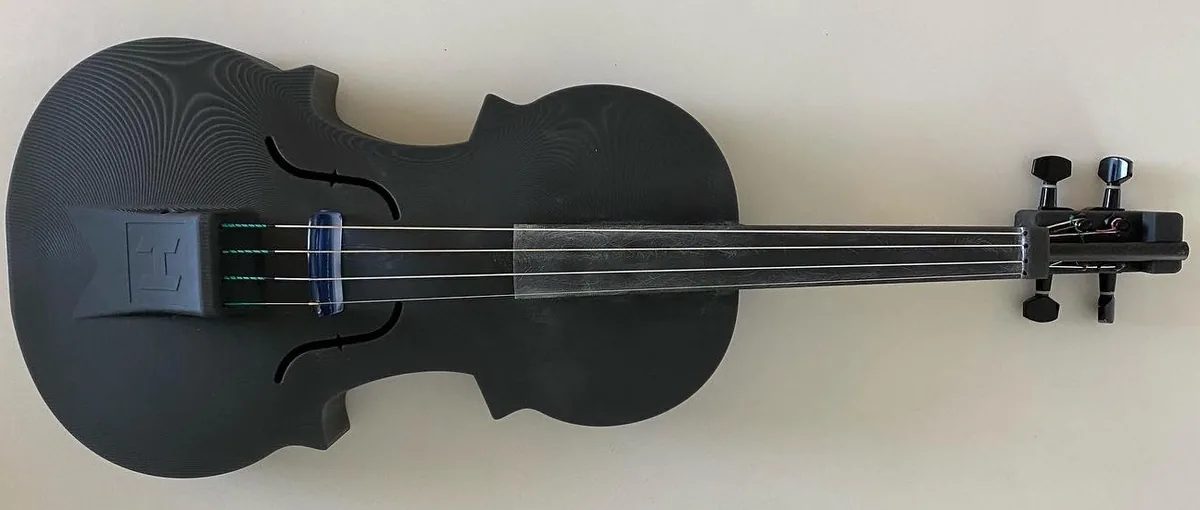
About the Hovalin
The Hovalin is one of the best-known open-source printed violins. It's a real acoustic instrument, not a prop or a silent electric body. You print a hollow chamber and a neck, run a carbon-fibre rod through both to carry the string tension, and fit ordinary violin tuners, strings and a bow. Matt Hova drew it in Fusion 360 and based its outline and proportions on a Stradivarius-pattern violin. It also owes something to David Perry's earlier FFFiddle.
It started as a side project at Hova Labs. Matt and Kaitlyn Hova wanted a violin that could light up in colours matching Kaitlyn's synesthesia. When the prototype turned out to be a playable instrument in its own right, they open-sourced it. Version 5.1.0 comes in full (4/4), three-quarter and half sizes, so it suits adult players as well as younger students.
Who it's for. It suits makers who own a printer and want a big, satisfying project, and teachers looking at low-cost instruments for a class. The designers point to school programmes where students used STEM funding to print instruments for their own music department. It's also a good choice for curious players who'd like a second violin they won't worry about.
Sound and playability. Expect a violin voice from a plastic body, not a match for a good carved wooden instrument. How it sounds depends a lot on your print, filament and strings, so watch the videos below and judge for yourself. The designer recommends standard student-to-mid-range strings and a normal bow and rosin, so it plays like any violin. They also say to sand the fingerboard smooth, because a rough printed surface can cause buzzing. The page suggests an under-bridge pickup if you want to amplify it. We haven't built one ourselves, so treat this section as a summary of the sources, not a review.
What you'll need
Printed parts
- The neck
- The body chamber, printed either as one piece or as three pieces
- Bowtie connectors to lock the three chamber pieces together (three-piece version only)
- Choose your size (4/4, 3/4 or 1/2) and a pre-supported or unsupported file set
- Any other small printed parts are in the download zips; the Printables page doesn't list every file, so check the zip for your size
Bought parts
- 4 violin tuners. The neck is sized for the specific tuners the designer links, so use those or check the dimensions carefully
- A carbon-fibre rod, 8 mm (5/16″) outside diameter × 500 mm long; no cutting needed
- A set of violin strings (the designer suggests common student and mid-range sets)
- A violin bow and rosin
- Optional: a violin pickup for amplification
- Chinrest, shoulder rest, bridge: the source doesn't say whether these are printed or bought. A printable Hovalin chin rest (CC BY, by another designer) exists if you need one
Tools
- A 3D printer. The designer says most standard consumer printers will do
- Minimum bed size isn't stated; the three-piece chamber is presumably the option for smaller beds
- A wrench (to snap the mounting tabs off the tuners) and a 10 mm hex/socket wrench to tighten them
- Sandpaper in a coarse-to-fine progression (around 100, 300 and 600 grit)
- Print removal tools; the designer also lists blue painter's tape
Build overview
Our own outline of the designer's instructions. Follow the full steps and pictures on the Printables page and in the assembly video.
- Pick a version and print. Choose the size, the one-piece or three-piece chamber, and a supported or unsupported file set, then print the neck and chamber parts.
- Clean up. Take off all brim and support material. Sand the fingerboard from coarse to fine grit until it's smooth, which cuts down on buzzing and looks better.
- Fit the tuners. Break off the tuners' screw tabs. Push each tuner through its hole in the head, then thread on its cap by hand and snug it with the 10 mm wrench.
- Join the chamber (three-piece version only). Slot the bowtie connectors in, matching the label on each connector to the label inside the chamber.
- Assemble the violin. Lock the neck onto the chamber. Slide the carbon-fibre rod down from the top of the neck through into the chamber until its end sits flush with the neck.
- String it up. Thread each string in at the bottom of the body, along to the hole at the top of the neck, and into its tuner. Bring the strings up to pitch gradually, then rosin the bow and play.
Print settings
- Walls: 3 perimeters (the Hovalin has thin walls)
- Infill: 20%, for any size or version
- Supports: both pre-supported and unsupported file sets are provided
- Filament, layer height, nozzle: not stated on the Printables page
Videos
 Play video: Hovalin Assembly Video (loads YouTube)
 Play video: A maker's build and review (loads YouTube)
Nothing loads from YouTube until you press play. Video thumbnails are © their creators.
Photos
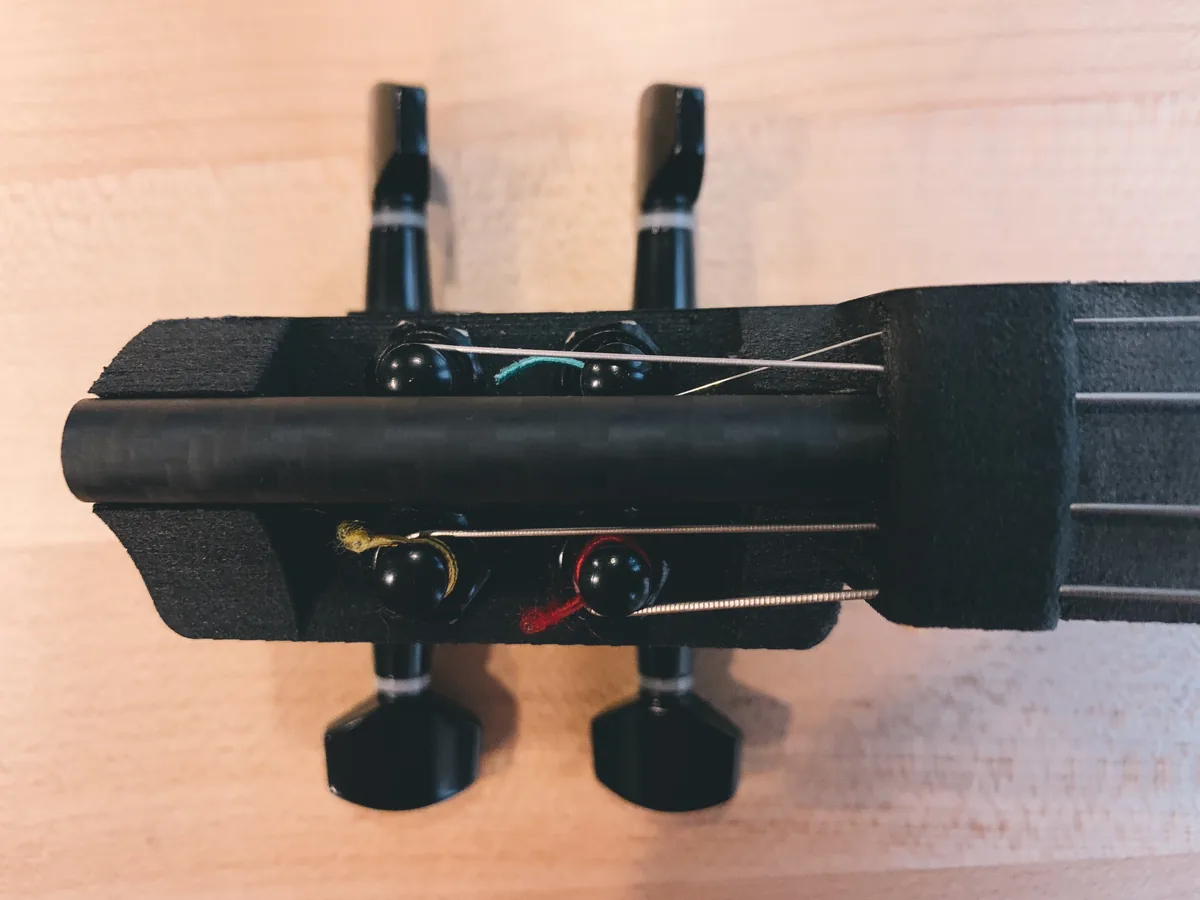
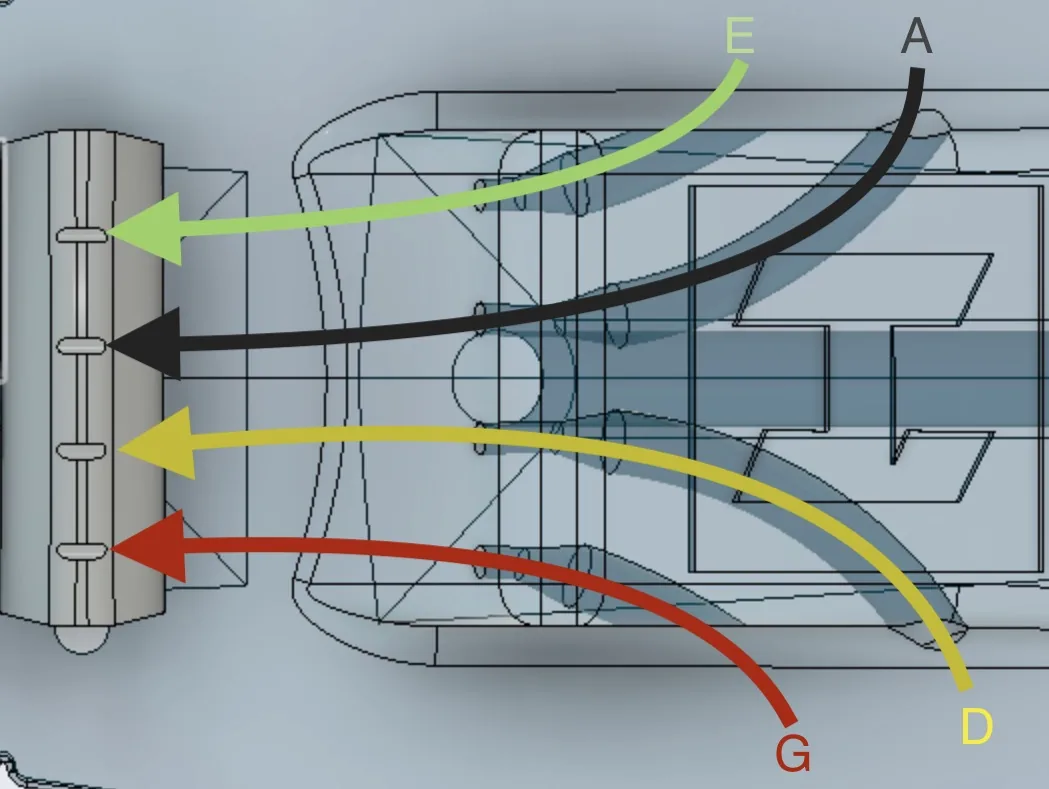
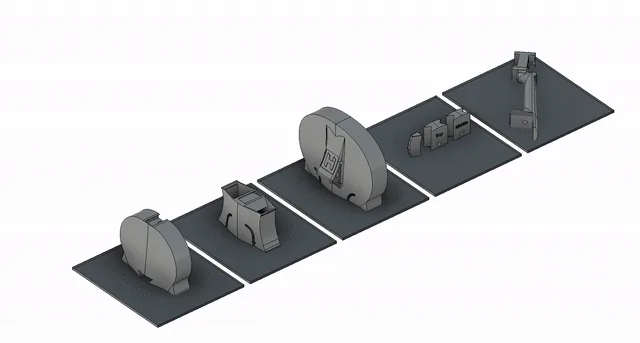
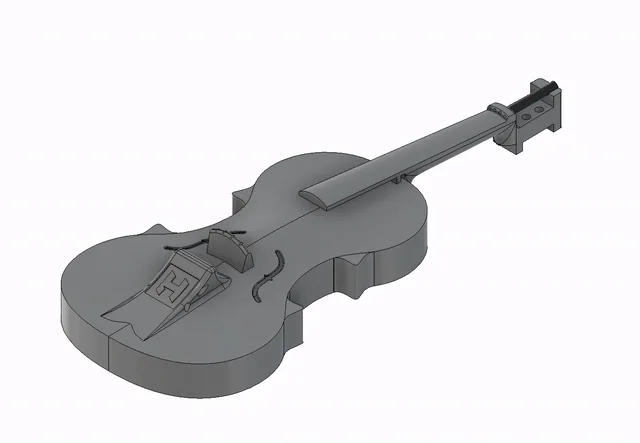
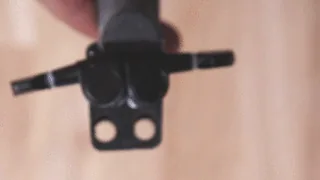
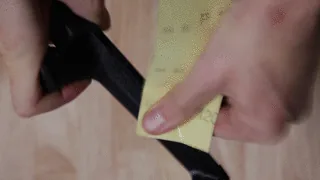
All photos and renders: Matt Hova, from the Hovalin page on Printables, licensed CC BY-SA. We resized them, converted them to WebP and took single frames from animations. These adapted versions are shared under the same licence.