
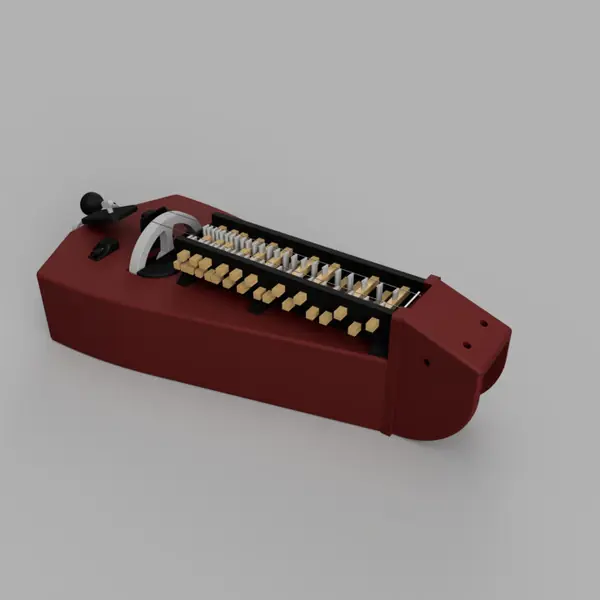
About the Hurdy Gurdy (wood hybrid)
A hurdy-gurdy is complex to build, especially if you aren't a skilled woodworker. So the designer printed the parts that are hard to make from wood, such as the wheel, keybox parts, tangents and bridges, and built a simple wooden body around them. It's set up for a 420 mm scale with two melody strings, one drone and one trompette, and he says you can change the number of strings, especially drones, without big changes.
The page lists the hardware: two 10 × 26 × 8 mm bearings, a 10 mm threaded-rod axle with nuts and self-locking nuts, shims to keep the wheel true, cheap banjo tuning pegs, M4 screws and plenty of M3 wood screws for the tangents. The keys are 9 × 9 mm wood, and the struts set a 10 cm inner height. Leave about 3 cm between the wheel and the bridge. He left out the highest keys because he didn't need them (he can reach high D). The video shows it playing a Breton dance. It's a different design from the Nerdy Gurdy and the electric hurdy-gurdy elsewhere in the library.
Who it's for. Hurdy-gurdy players and makers who can do simple woodwork but don't want to carve a wheel or keybox. The printed parts take care of the precision work, so the body can be a plain box built with basic tools.
What you'll need
Printed parts
- Wheel, keybox parts, tangents, bridges and struts
Bought parts
- 2 bearings, 10 mm ID × 26 mm OD × 8 mm
- 10 mm threaded rod, nuts and self-locking nuts
- Round shims
- Tuning pegs (banjo pegs used)
- M4 screws and nuts; M3 wood screws
- 9 × 9 mm wood for the keys, and wood for the body
- Hurdy-gurdy strings
Tools
- Basic woodworking tools
Build overview
Our own outline of the designer's notes on MyMiniFactory.
- Print the parts. Wheel, keybox halves and supports, long and short tangents, nut, the main, drone and trompette bridges, crank parts, bearing struts and the strap pin.
- Build the body. Make a wooden box around the printed bearing struts; they're 10 cm tall, which sets the inside height of the instrument.
- Make the keys. Cut keys from 9 × 9 mm wood and screw the printed tangents on with M3 wood screws. The designer left out the highest keys, which need extra shaping, since he can reach high D without them.
- Fit the wheel. Glue two 10 mm nuts into the wheel. Feed the threaded-rod axle in from the back and screw it through the wheel, holding the wheel in place, until it reaches the front strut. Use shims and self-locking nuts to keep the wheel straight and lock the crank.
- Set the bridges. Mount the bridges with M4 screws and nuts, leaving about 3 cm between the wheel and the bridge. The designer says he learned that the hard way. He tied the tension plate down with wire to a screw at the bottom of the instrument.
- String and play. Fit the tuning pegs (he used cheap banjo pegs), string two melody strings, a drone and a trompette, and rosin the wheel.
Video
 Play video: 3D-printed hurdy-gurdy test: Breton An Dro (loads YouTube)
Nothing loads from YouTube until you press play. Video thumbnails are © their creators.
Photos
We only use MyMiniFactory's main image for the card, so the other photos stay on MyMiniFactory. See them on MyMiniFactory ↗