
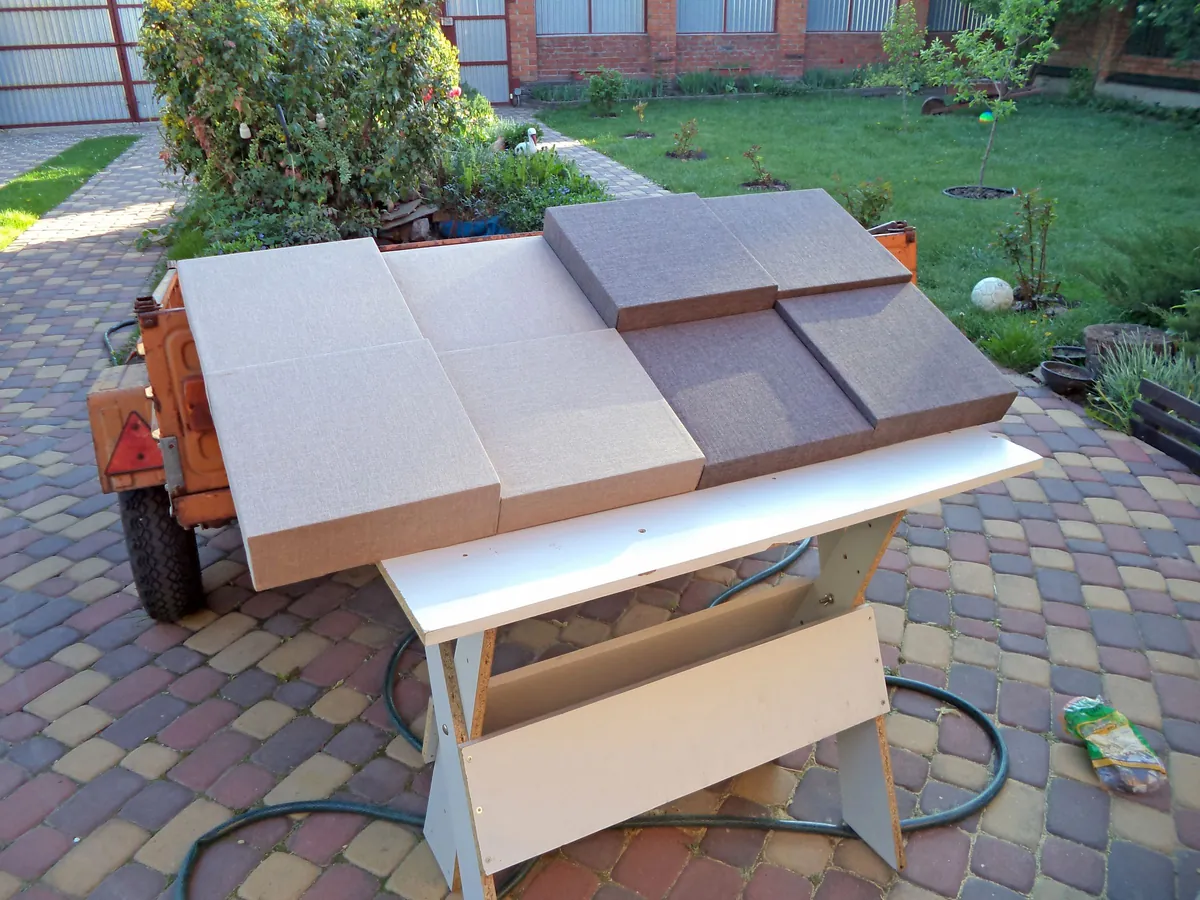
About the acoustic panels
Waldemar Sha made a test batch of acoustic panels to order and documented the process. Each panel is a shallow box, 300 × 300 mm and 50 to 95 mm deep, made from 10 mm MDF (plywood works too, he says). The wall pieces have routed grooves so they fit around the base, and he glues them using a clamp made from old bicycle tyres cut into rings and some wooden blocks.
The boxes are packed with dense acoustic mineral wool, lined with Tyvek so wool fibres can't escape through the fabric, then wrapped in fabric stapled at the back. He explains how to size the fabric and fold the corners neatly.
He built them for a home cinema; panels like these are also widely used to cut reflections in practice and recording rooms. The guide doesn't finish the wall mounting, but he suggests a French cleat. The spelling "Pannels" in the original title is the author's.
Safety. Mineral wool irritates skin and lungs, so wear gloves, long sleeves and a mask when cutting it. We haven't built these ourselves; this summarises the author's guide.
What you'll need
Materials
- 10 mm MDF or plywood for the boxes
- 20 mm thick acoustic mineral wool
- Tyvek sheet (about 36 × 36 cm per panel)
- Fabric for the covers (about 44 × 44 cm for a 5 cm-deep panel)
- Wood glue (latex or PVA)
Tools
- A saw, or have the MDF cut to size (the author had the parts cut for him)
- A router table for the grooves
- Old bicycle tyres and wooden blocks for clamping (or a nail gun)
- A flush-trim router bit
- A knife for the wool (the author used an electric knife)
- A staple gun
- Gloves and a mask for the mineral wool
Build overview
Our own outline of the author's 17 steps. Dimensions, cutting diagrams and photos are on Instructables.
- Cut the parts. Cut the MDF bases and walls; the author includes a cutting diagram for eight panels from one sheet.
- Rout the grooves. Cut matching grooves in each wall piece on a router table.
- Glue the boxes. Glue the walls around the base and clamp them with rubber rings and blocks, then trim the corners flush.
- Fill with wool. Cut the mineral wool slightly oversize and pack it in.
- Add the Tyvek. Tuck a Tyvek sheet over the wool to stop fibres escaping.
- Wrap in fabric. Stretch the fabric over the front, staple opposite sides in turn, and fold the corners.
Videos
 Play video: Cutting the mineral wool (loads YouTube)
 Play video: Filling a panel (loads YouTube)
Nothing loads from YouTube until you press play. Video thumbnails are © their creators.