

About the Djembe
A drummer wanted to know whether a great-sounding instrument could be printed, and this djembe exceeded her expectations. The drumheads and shells are interchangeable, so you can experiment with the sound. She suggests starting with the 5-inch drum: a 0.8 mm head in PLA on a 3 mm shell.
The drumhead membrane must be 100% infill, and the decorative fringe can be less. A thinner membrane gives a lower pitch (on the 5-inch, 0.4 mm is lowest and 1 mm highest). Brittle filaments sound more metallic, while softer PLA sounds warmer, more like skin. The shell should also be 100% infill, and its filament matters little. Thicker shells give more bass-to-rim contrast. The head is a friction fit. If the shell shrinks and the head is loose, a few layers of tape on the shell's rim fix it, and they're also a way to tune. Sand sharp edges off PETG heads. Her sound-test videos show both sizes.
Who it's for. Anyone with an ordinary printer who wants a real drum, and drummers curious about how filament changes the sound. It needs no hardware at all for the 5-inch version, and the designer's list of the exact heads, shells and filaments used in her videos makes it easy to reproduce a sound you like.
Sound. The designer's videos show black, silver, green and translucent drums side by side. The black one has a 0.6 mm Prusament PLA head on a 2 mm shell, the silver a 0.8 mm head on a 3 mm shell, and the green a 1 mm head on a 4 mm shell. The translucent one is all PETG. We haven't built one ourselves, so listen to the videos and judge for yourself.
What you'll need
Printed parts
- Shell (5 in or 7 in bolt-joined)
- Drumhead(s) in different thicknesses
Bought parts
- For the 7 in shell: 3 × M3 × 10 bolts and nuts
- Tape (for fit and tuning)
Tools
- Sandpaper
Build overview
Our own outline of the designer's notes. The full description is on the Printables page.
- Choose a size and head. Start with the designer's favourite: the 5-inch drum with a 0.8 mm PLA head on a 3 mm shell. A thinner head sounds lower and a thicker one higher.
- Print the shell. 100% infill. Thicker shells give more contrast between bass and rim tones and support the head better; the filament matters little here.
- Print the head. The membrane must be 100% infill; the decorative hex fringe can be lighter. PLA gives the warmest, most skin-like sound.
- Clean up. Sand any sharp top edges off the head (likely with PETG) so it won't hurt your hands.
- Fit the head. Press it onto the shell; it's a friction fit. For the 7-inch version, join the shell sections with three M3 × 10 bolts and nuts first.
- Tune with tape. If the head is loose or you want a different sound, add a few layers of tape around the top of the shell to widen it slightly. The designer says it can get surprisingly ringy.
Print settings
- Drumhead: 100% infill (fringe can be less); PLA suggested
- Shell: 100% infill, 2–3 mm walls
Videos
 Play video: Djembe sound test (loads YouTube)
 Play video: The 7-inch djembe (loads YouTube)
Nothing loads from YouTube until you press play. Video thumbnails are © their creators.
Photos
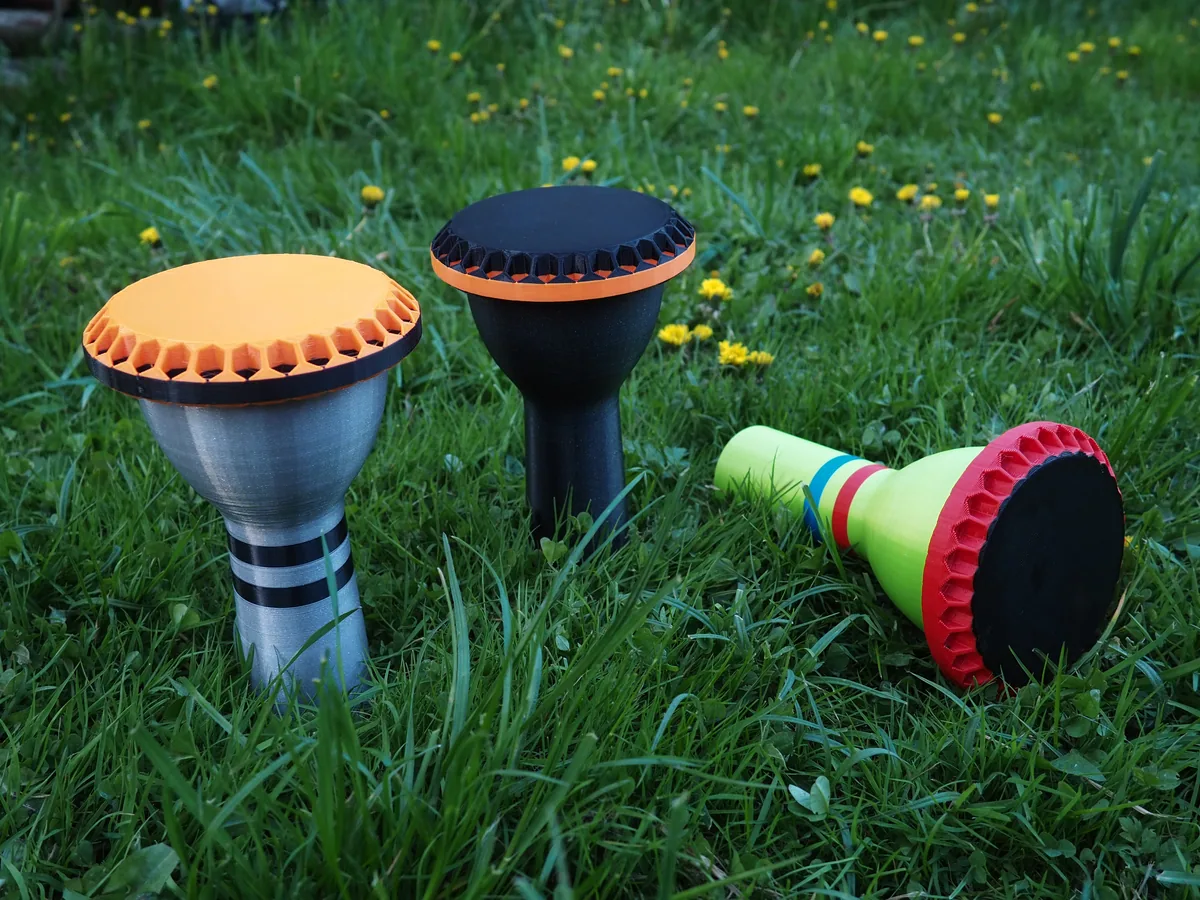
All photos: Ania Kompa, from the design page on Printables, licensed CC BY-NC-SA. We resized them and converted them to WebP. These adapted versions are shared under the same licence.