
About the DigiGurdy
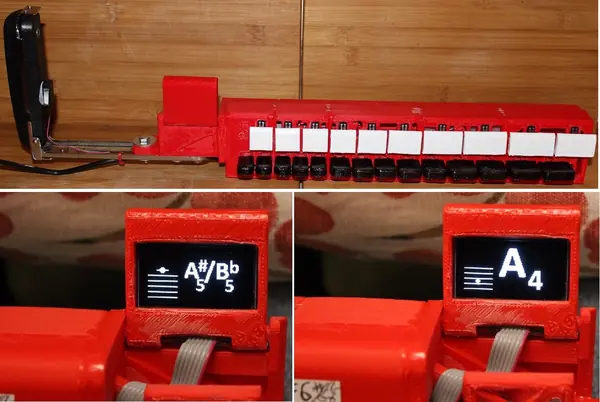
Hurdy-gurdies are loud and expensive. Good instruments cost around €1,500 and often have a year's waiting list. Bagpipers have practice chanters, but hurdy-gurdy players had no equivalent, so the designer built one after making a Nerdy Gurdy. The DigiGurdy is a fully printed keybox with the keys spaced as on a real instrument. Each key presses a microswitch, and a Teensy board sends MIDI over USB to a laptop or phone running a synth. With headphones it's silent, and it needs no battery.
An OLED screen shows the note you're playing, and a demonstration mode plays tunes at your chosen speed with the notes on screen. A separate document explains pairing it with a commercial sampled hurdy-gurdy library on a laptop, for drones and trompette sounds. The designer has updated the keys for a shorter travel. Note that OLED screens differ in pin labels, and the page has notes on choosing one. A build manual PDF and the Teensy code are in the files.
A later version. In 2021 the designer posted the Digi-Nerdy-Gurdy, a redesign made with Nerdy Gurdy designer Jaap Brand: a new PCB, new keys, a laser-cut plywood keybox that can dock into a soundbox, and build videos. We still list this original because it's fully printed and its files include the build manual and code, while the newer one needs laser cutting and its page asks you to message the designer for the PCB design and soundfont. It's linked below.
The Thingiverse page links performance videos by hurdy-gurdy players as inspiration, not as demos of this device, so we haven't embedded them.
What you'll need
Printed parts
- Modular keybox sections and keys
Bought parts
- Teensy 3.6
- Microswitches (one per key)
- OLED display (check the page's notes on types)
- USB cable
Tools
- Soldering iron
- A computer to flash the Teensy
- MIDI synth software, with headphones
Photos
Thingiverse doesn't let us fetch its gallery, so the photos stay on Thingiverse. See them on Thingiverse ↗