
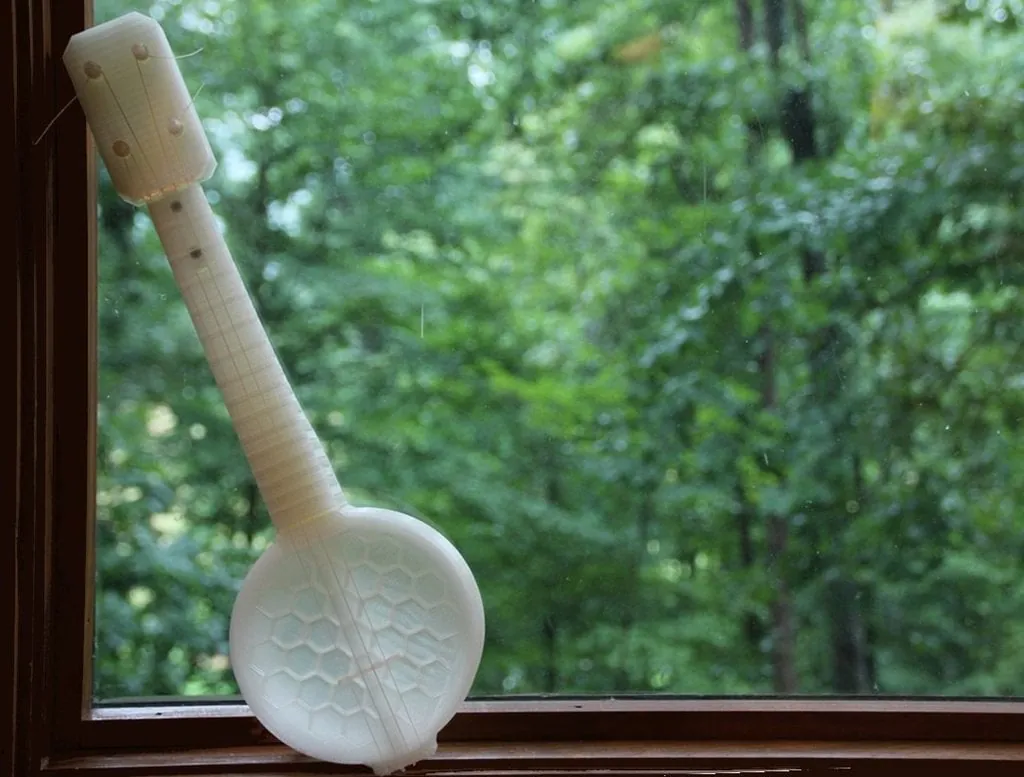
About the Banjolele
A banjo ukulele (banjolele) is a ukulele with a small banjo body: a thin, resonant membrane stretched over an open-backed frame. Andreas Bastian thought that kind of body suited 3D printing, so instead of a skin, this design prints the head itself as a very thin membrane held up by a hexagonal web. He started in May 2013 after printing a Makerlele, and worked on the design over several weeks with Geoff Wiley of the Jalopy Theater in Brooklyn, who lent him an old banjo-uke frame to measure.
The head section is swappable so you can experiment with it. The files also include earlier body revisions with different bridge supports (rev1), webbing patterns (rev2 and rev3) and membrane thicknesses (rev4). The designer says all of them change the tone a lot. He also compared spectrograms of the printed uke with a classic wooden ukulele and found that the printed one has more high-frequency content.
Sound and playability. The designer says the finished version holds pitch and has a nice, full tone, but still needs some work. It's one of the older designs in the library (2013), and it's a good one to pick if you're curious about how a printed membrane sounds. We haven't built one ourselves, so treat this page as a summary of the designer's notes, not a review.
What you'll need
Printed parts
- The body (body_rev5 is the latest; rev1–4 are earlier experiments)
- Neck and headstock
- Nut and bridge
- Tuning pegs
- The two plate files (PLATE_1, PLATE_2); the page doesn't say exactly what they hold
Bought parts
- A set of ukulele strings
- Glue or screws to join the neck and headstock; the description we could read doesn't say
Tools
- A 3D printer
- A craft knife and sandpaper for cleaning up the parts
The parts are taken from the design's file list on Thingiverse. Lines marked as uncertain aren't confirmed by the designer's description.
Build overview
Our own outline, from the designer's description and file list. Read the Thingiverse page before you start.
- Pick a body. Print body_rev5, the latest revision. The rev1–4 bodies are there for comparison if you want to hear how bracing, webbing and membrane thickness change the sound.
- Print the rest. Print the neck, headstock, nut, bridge and tuning pegs.
- Assemble and string it. Put the neck and body together, fit the nut and bridge, and string it like a ukulele.
- Experiment with the head. The head section is swappable, so you can try other membrane designs without reprinting the whole body.
Print settings
- Material: Not stated in the description we could read
- Membrane: 0.5 mm thick on hexagonal webbing (rev5), per the designer
Video
 Play video: 3D Printed Banjo Ukulele (loads YouTube)
Nothing loads from YouTube until you press play. Video thumbnails are © their creators.
Photos
Thingiverse doesn't let us fetch its gallery, so the photos stay on Thingiverse. See them on Thingiverse ↗