
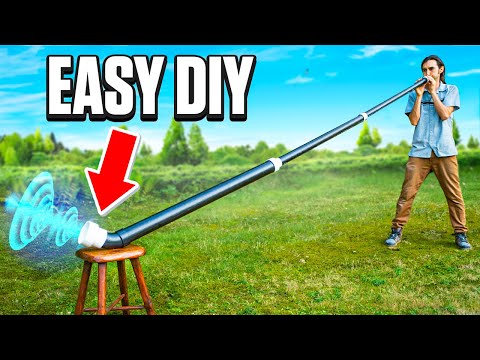
About the PVC didgeridoo
Didge Project is run by didgeridoo teacher and performer AJ Block, who runs school workshops where every student goes home with an instrument. This guide collects what he's learned about turning plain plumbing pipe into didgeridoos, from the simplest possible version to more complex spiral and slide designs.
The basic didge needs no tools, glue or skill: a length of 1½″ PVC or ABS pipe and a 1½″ × 1¼″ DWV trap adapter snapped on as the mouthpiece. Length sets the key. For a beginner he suggests D, at roughly 43½″ of pipe; for workshops he cuts 10′ lengths into thirds, giving about 40″ each, in E. A chart in the article covers other keys for the straight design.
The companion video shows four designs, ending with a slide didgeridoo modelled on a premium commercial instrument, and a free 27-page eBook goes further (the site asks for an email address to send it). Spiral designs use 1½″ street elbows.
Who it's for. Anyone curious about the didgeridoo, teachers and youth groups. Learning to play it (and circular breathing) is the hard part; the building is easy. This is a summary of the guide and video; we haven't built one ourselves.
What you'll need
Materials
- 1½″ PVC or ABS pipe: a 5′ length, or two 2′ lengths with a coupling
- A 1½″ × 1¼″ PVC or ABS DWV trap adapter for the mouthpiece
- Optional: couplings and 1½″ street elbows for longer or spiral designs
- Optional: extra parts for the slide design (see the video)
Tools
- None for the basic design
- A hacksaw (or chop saw, used carefully) to cut pipe to length for a chosen key
Build overview
Our own outline of the basic design. The article and video cover the more advanced ones; see Didge Project.
- Pick a key. D (about 43½″ of pipe) is a good beginner key; about 40″ gives E. Use the article's chart for others.
- Cut the pipe. Cut 1½″ PVC or ABS pipe to length with a hacksaw, or join two shorter lengths with a coupling.
- Add the mouthpiece. Snap on a 1½″ × 1¼″ DWV trap adapter. No glue is needed on the mouthpiece.
- Go further. Try the video's longer, spiral and slide designs, or the free eBook's details on tuning.
Video
 Play video: The build guide: four designs (loads YouTube)
The videos don't load from YouTube until you press play. Video thumbnails are © their creators.