
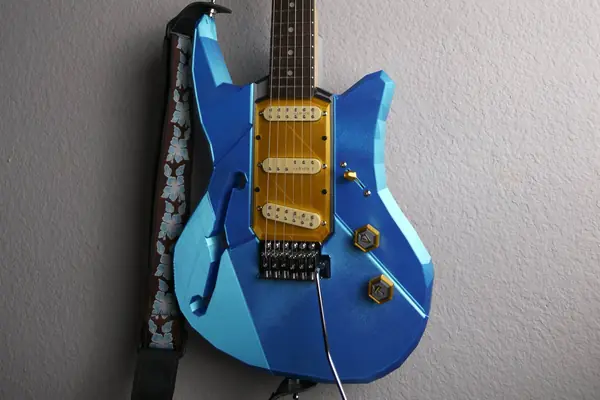
About the Polycaster
The Polycaster's neck pocket and bridge follow a 60s Stratocaster, so any 25.5-inch Strat neck or Fender-replacement neck should fit. The designer used a spare aftermarket neck, shaved its heel a few millimetres because it was made for a deeper pocket, and found everything lined up without even intonating. The body is six epoxied pieces. The centre is 100% infill and uses almost a whole roll, taking about 2.5 days. The outer pieces are 15% infill, or 25% where screws go, and take 9–17 hours each, all from one more roll. Total print time was about 9 days.
The centre needs supports either for the spring cavity or for the neck and pickup areas, depending on how you orient it. The largest outer piece needs them at the output jack. Depending on your pickups you may need to drill extra wire holes. The designer's video shows the whole build and how it sounds.
Who it's for. Guitarists who already have, or can buy, a Strat-style neck and hardware and want a body that's truly their own. It's a big filament and time commitment, so it suits someone with a reliable printer who doesn't mind a printer running for more than a week.
Sound and playability. Because the neck, bridge and pickups are ordinary guitar parts, it plays like a Strat; the printed body mainly changes weight and looks. The designer's video lets you hear it. We haven't built one ourselves.
What you'll need
Printed parts
- Body (6 pieces)
- Pick-guard, knobs, backplate
Bought parts
- A 25.5 in Strat or Fender-replacement neck
- Strat-style bridge, pickups and electronics
- Epoxy
- Strings and screws
Tools
- Drill
- Soldering iron
Build overview
Our own outline of the designer's notes on Thingiverse and his build video.
- Print the centre. The main middle piece at 100% infill, with supports: under the spring cavity if printed one way up, or under the neck and pickup areas the other way. It takes about 2.5 days and nearly a full roll.
- Print the outer body pieces. Five pieces at 15% infill, or 25% for the ones that take screws, 9–17 hours each. The biggest needs supports at the output jack.
- Print the small parts. Pickguard, knobs and back plate take a few hours in total.
- Epoxy the body. Glue the six body pieces together with epoxy.
- Fit the neck. Any 25.5 in Strat or Fender-replacement neck should fit the 60s-Strat-spec pocket. The designer had to shave a few millimetres off his neck's heel because it was made for a deeper pocket.
- Wire and string. Fit the bridge, pickups and electronics, drilling an extra wire hole or two if your pickup leads are thick, then string it up and set it up as usual.
Print settings
- Centre piece: 100% infill, supports
- Outer pieces: 15% (25% where screws go)
Video
 Play video: I made a 3D-printed custom guitar: the Polycaster (loads YouTube)
Nothing loads from YouTube until you press play. Video thumbnails are © their creators.
Photos
Thingiverse doesn't let us fetch its gallery, so the photos stay on Thingiverse. See them on Thingiverse ↗