
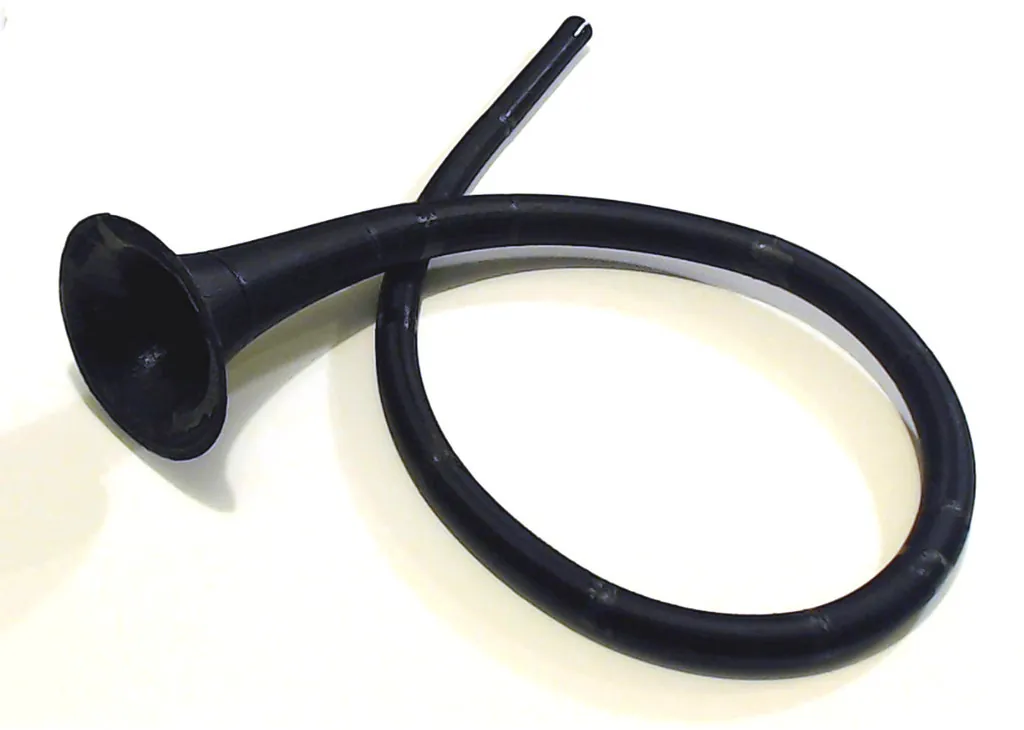
About the OpenBrass trumpet
OpenBrass is a French association that studied how to design brass instruments for 3D printing. This trumpet was its first prototype. It's a natural trumpet, with no valves, so you play the notes of the harmonic series with your lips, like a bugle. The bell is based on acoustic studies of a Bessel bell, including the paper "Trumpet with near-perfect harmonicity: Design and acoustic results", and the other dimensions come from a professional valve trumpet. The designer changed details such as wall thickness and sleeves based on other acoustic studies. It was modelled in OpenSCAD.
Sound and playability. Several professional musicians who tried it found the sound very centred, the designer says, and the audio on the project page was recorded by a trumpeter from the Orchestre National des Pays de la Loire (ONPL). High notes are a little harder with a standard Bach 1½C mouthpiece, probably because the design is more open than a normal trumpet. A better-matched mouthpiece fixes that. Overall he found it quite playable, with no major defects.
Build notes. The trumpet is printed as many short pieces, each a few inches long, and welded together with acetone. The designer's printer settings weren't finished when he made it, so the first print was porous and couldn't be played until he sealed the inside with a saturated acetone solution. He says that shouldn't normally be needed. For the next prototype he planned to add a tuning slide, revise the leadpipe, reduce the thickness and improve the joints, so treat this one as an experiment. We haven't built one ourselves, so this page summarises the designer's notes; it isn't a review.
What you'll need
Printed parts
- The trumpet sections (many short pieces)
Bought parts
- Acetone, to weld the pieces together
- A standard trumpet mouthpiece (or print one)
Tools
- A 3D printer
- Gloves and good ventilation when you work with acetone
The project page doesn't give a full parts list. The safety line is our own advice.
Build overview
Our own outline of the designer's notes on openbrass.org.
- Print the sections. Dial in your printer first: the designer's porous first print came from unfinished printer settings.
- Weld them together. Join the short pieces with acetone.
- Seal if needed. If it leaks air, coat the inside with a saturated acetone solution, as the designer did. This also smoothed some rough spots.
- Play. Fit a trumpet mouthpiece and play the natural harmonics.
Print settings
- Material: ABS, implied by the acetone welding; the source doesn't say
- Pieces: Many short sections, a few inches each
- Airtightness: Get your printer settings right to avoid a porous bore
Videos
 Play video: The B♭ trumpet prototype (loads YouTube)
 Play video: Il silenzio: printed and metal trumpet duet (loads YouTube)
Nothing loads from YouTube until you press play. Video thumbnails are © their creators.
Photos
Thingiverse doesn't let us fetch its gallery, so the photos stay on Thingiverse. See them on Thingiverse ↗