
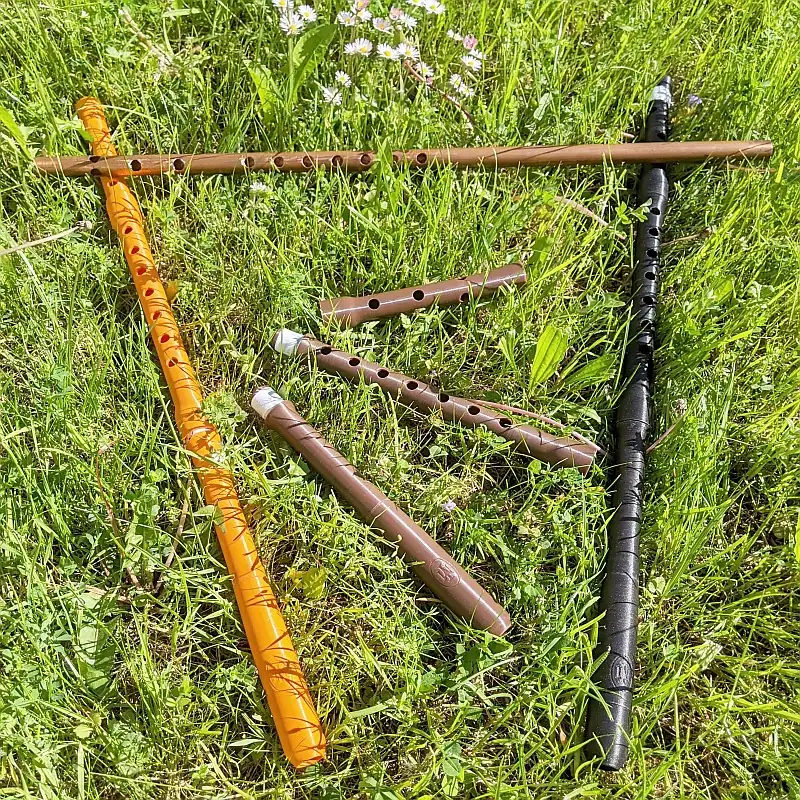
About the kaval
The kaval is an end-blown shepherd's flute and one of Bulgaria's national folk instruments. It's open at both ends, and you play it by blowing against the sharp edge of the top rim. Ivko's first printed kaval in D follows the 16 mm bore described by Todor Prashanov in his 1966 book, with the tone holes 25 mm apart. Version 3.12 is a reworked design: the bore now tapers from 16.5 to 15 mm, the tone-hole positions and widths have been recalculated, and the first section has a new inner shape.
The kaval comes in three sections (the designer calls them Ekleme 1, 2 and 3) that plug together without glue. On the original version, the designer used PTFE tape for a snug fit and left a small gap at the joints so the kaval can be tuned. Because his printer prints only 20 cm high, he also split the long sections into two pieces each, glued together with two-part epoxy. The v3.12 parts must be printed standing up, because lying down ruins the inside structure.
A note on versions. The designer calls v3.12 a work in progress: it works, but he found a few things that didn't fit and started a completely new version, and he has since published a v4.41. His detailed build notes are on the original kaval's page, and the v3.12 page tells you to read them. He also links a sound sample and, from the original page, how to get the first note and a fingering chart.
Why we still list v3.12. We checked the designer's v4.41 (October 2026). Its Thingiverse page (thing:5957965) is now titled 'no free' and says it's a demo, not a printable version, with a version to buy instead, and it carries a stricter CC BY-NC-ND licence. v3.12 is the latest free version, so we keep it.
Who it's for. Folk-music players and anyone curious about the kaval who has a printer and some patience for finishing. The designer is careful to say how he did it rather than promise exact tuning. We haven't built one ourselves, so treat this page as a summary of the designer's notes, not a review.
What you'll need
Printed parts
- The three sections (Ekleme 1, 2 and 3)
- Split halves of the long sections for short printers, as on the original version
Bought parts
- PTFE (Teflon) tape for the plug joints
- Two-part epoxy, if you print the split halves
Tools
- A 3D printer (standing parts; the long sections are split for 20 cm of height)
- Sandpaper to sharpen the blowing edge
- A round file to smooth the bore
Build overview
Our own outline. The v1 page on Cults3D has the designer's full notes, which the v3.12 page tells you to read.
- Print standing up. Print each section upright. Lying down ruins the inside structure of v3.12.
- Glue split halves. If you printed sections 1 and 2 as a and b halves, glue each pair with two-part epoxy.
- Sharpen the blowing edge. Shape the top edge with sandpaper until it's really sharp. Do this before gluing, in case something goes wrong.
- Smooth the bore. File out any bumps inside the tube with a round file, turning the piece so the wall is filed evenly.
- Assemble and tune. Plug the sections together (PTFE tape helps the fit), leaving a small gap at the joints to tune it.
Print settings
- Orientation: Standing up only (v3.12)
- Height: Long sections are split for printers that print up to 20 cm high
- Material: Not stated for v3.12
Photos
Thingiverse doesn't let us fetch its gallery, so the photos stay on Thingiverse. See them on Thingiverse ↗